Modifiers in Horses
Modifiers change the appearance of the horse coat color. They are similar to dilutions but have different effects.
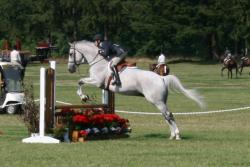
Photo by Dierdre O'Brien.
Gray is a dominant modifier that changes the coat color to white over the years. It can affect any color or color combination. Gray horses are often born with a fully colored coat, like an adult horse: i.e. a bay foal would be born with black legs, rather than pale colored legs that come in black after the foal shed. Other signs that experienced breeders look for are: chestnut foals who are born with dark skin, instead of pink hued skin; and telltale white hairs - even one - in the eyelashes or around the eyes. Graying often begins on the face, creating "gray goggles" around the eyes of foals. But horses can begin to gray on almost any part of the body. Some horses, in particular very dark or black horses, have been observed to begin graying as late as nine years old. Some foals are born having already begun the graying process. Grey horses will have dark eyes and skin (if another dilution, modifier or white pattern has not changed them). More Examples of Gray
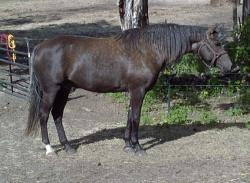
A Sooty Palomino (verified by genetic testing)Summer coat, photo courtesy of Diane Blanzy.
Sooty (sometimes called smutty) is a modifier that causes black hairs to be mixed into the coat. Generally, the effect is as if someone had dumped a bucket of soot over the horse's head and back. It seems to act as a form of countershading. The dark pigment can also be distributed evenly throughout the coat or concentrated on the mane, tail, legs or other parts of the body. It may express itself as smudges, patches, striping, spots, or dappling. It can mimic primitive markings. It is believed to create dark bays, possibly dark chestnuts, as well as dark palominos and buckskins. There is debate over whether it causes liver or black chestnuts, and seal bays or browns. Sooty tends to vary seasonally and is susceptible to bleaching and the general condition of the coat caused by grooming, stabling and nutrition. It is not known at this time what causes sooty. More Examples of Sooty
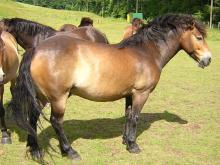
Freddy is an unregistered 10 year old Exmoor pony gelding belonging to Edinburgh University Exmoor Pony Trekking Section
Pangaré (also called mealy) is a modifier that lightens the coat of chestnut and bay horses along the flanks, belly, inner legs, at the muzzle and around the eyes. It often presents as flaxen in chestnut horses. It is believed to not express on black horses. The inheritance of pangaré is not understood.
More Examples of Pangare
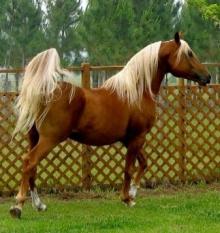
Arabian stallion FC Casino Royale Photo courtesy of The Inverted Y
Flaxen is a modifier that lightens hairs in the mane and tail of chestnut horses. It may also affect the lower legs. It is sometimes confused with palomino or silver. It can appear on both very dark (liver) chestnuts or light chestnuts. It may vary in its effect, or appear or disappear as the horse ages. The inheritance of flaxen is not well understood but it is most likely recessive or polygenic in inheritance.
More Examples of Flaxen
Comments Page
The only studies that have
The only studies that have looked at Agouti affecting chestnut shade have found no correlation. Given that the extension and agouti tests has been around for quite a long time if there was a correlation it would have been found by now.
The theory is that they don't produce black pigment only very dark red pigment. Theoretically this is possible.
I have a chestnut foal both
I have a chestnut foal both sire and dam are bay.
It now looks like his mane is going to grow out flaxen. Is it possible to get a flaxen chestnut from two bays?
The Dam is a light golden bay and could very well be a golden buckskin. I will be getting her color tested to make sure.
Sooty VS dark chestnut
If chestnut is anything like recessive red in dogs then a chestnut horse shouldn't be able to produce any black pigment, and so couldn't have sooty. I read somewhere that there are studies about how underlying agouti variation can change the shade of red in a chestnut; but this seems a bit odd.
what is the difference between dogs and horses as far as the extension gene goes?